Safety Matters: Why Your Car Needs ADAS Calibration After an Alignment
If you’ve lived around Shippensburg for a while, you know that our roads can be a bit of a mixed bag. Between the seasonal changes and the occasional pothole on King Street, keeping your car’s alignment in check is just a part of life. Most of us know the drill: the steering wheel feels a little off-center, or the car starts pulling to the right, so you bring it into Dettwiler Brother’s Repair for an alignment.
You get your car back, the steering is straight, and everything feels great. But if you’re driving a vehicle made within the last decade, there’s a crucial second step that often gets overlooked: ADAS calibration.
At first glance, adjusting your tires and calibrating a computer sensor might seem like two completely different jobs. However, in the world of modern automotive safety, they are tied together at the hip. Skipping this step isn’t just a matter of “maintenance”, it’s a matter of safety. Let’s dive into the truth about why your car’s “brain” needs to be synced with its “feet” after an alignment.
What Exactly is ADAS?
Before we talk about why calibration is necessary, let’s clear up what ADAS actually is. ADAS stands for Advanced Driver Assistance Systems. You might not know the acronym, but you definitely know the features. These are the “digital guardian angels” built into your car, including:
- Lane Departure Warning: That beep or vibration you get when you drift over the line.
- Automatic Emergency Braking (AEB): When your car slams on the brakes because it senses a collision before you do.
- Adaptive Cruise Control: The system that keeps a set distance between you and the car in front.
- Blind Spot Detection: Those little glowing icons in your side mirrors.
These systems rely on a network of cameras, radar, and sensors hidden behind your windshield, in your bumper, or behind your grille. They are incredibly sensitive and designed to see the road with mathematical precision.

The “Invisible Connection”: Why Alignment Changes Everything
Think of your car’s alignment as its posture. When we perform a wheel alignment, we are adjusting the angles of the wheels so they are parallel to each other and perpendicular to the ground. This ensures your tires wear evenly and your car tracks straight.
Now, imagine you’re wearing a pair of high-tech augmented reality glasses that highlight the path in front of you. If someone nudges your glasses just a fraction of a millimeter to the left, the path you “see” won’t match where your feet are actually stepping.
That is exactly what happens to your car’s ADAS sensors after an alignment. When we adjust the mechanical components of your suspension, we change the “thrust angle”, the direction the rear wheels are pointing relative to the center of the car. Even a tiny adjustment to the wheels changes the physical orientation of the entire vehicle body. Since the cameras and radar are mounted to that body, they are now “looking” in a slightly different direction than they were before.
The Danger of “Ghost Braking” and Drifting
You might think, “Is a fraction of a degree really that big of a deal?” In the world of ADAS, it’s a massive deal.
If your forward-facing camera is off by just one degree, it might be looking at the lane next to you instead of the lane you’re in. This can lead to several dangerous scenarios:
- False Interventions: Your car might think a car in the adjacent lane is actually a stalled vehicle in your lane, causing it to suddenly slam on the brakes. This is often called “ghost braking,” and it’s a terrifying experience, especially at highway speeds.
- Delayed Reactions: Conversely, if the sensor is misaligned, it might not “see” a hazard until it’s too late, rendering your Automatic Emergency Braking useless when you actually need it.
- Inaccurate Lane Keeping: If your Lane Keep Assist thinks the center of the lane is two feet to the right of where it actually is, the car will constantly try to steer you off the road or into another vehicle.
When you bring your vehicle to us for diagnostic services, we use specialized equipment to ensure these digital systems are perfectly synchronized with your mechanical alignment.
The Steering Angle Sensor: The Missing Link
One of the most important parts of this puzzle is the Steering Angle Sensor (SAS). This sensor tells your car’s computer exactly where the steering wheel is pointed.
During an alignment, we physically straighten the wheels. However, the computer might still “think” the steering wheel is turned slightly to the left based on the old alignment data. If the SAS isn’t recalibrated (or “re-zeroed”) after the alignment, the Electronic Stability Control (ESC) might get confused. It might think the car is skidding when it’s actually driving straight, leading to unnecessary braking or power reduction.
In Shippensburg, where we deal with slippery winter roads and wet spring mornings, you need your stability control to be 100% accurate. A confused computer is the last thing you want when you’re trying to navigate a slick turn.

Static vs. Dynamic Calibration: How We Do It
At Dettwiler Brother’s Repair, we don’t just “eyeball” it. ADAS calibration requires specialized tools and a controlled environment. Depending on your vehicle’s make and model, there are two types of calibration we might perform:
Static Calibration
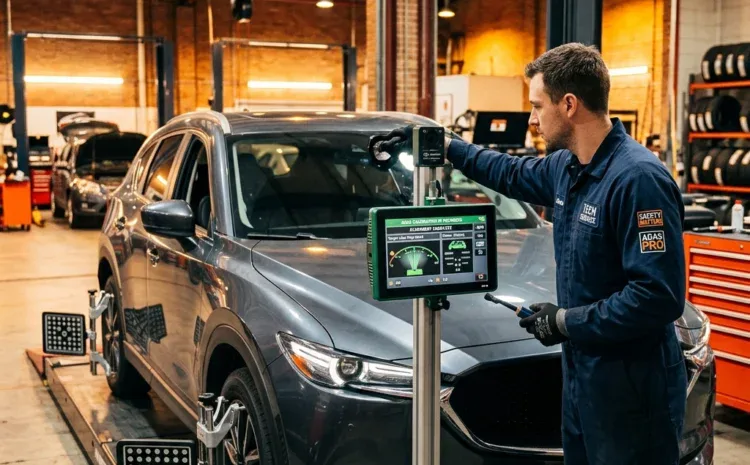
This happens right here in our shop. We set up specialized targets (they look like large checkerboards or patterns) at specific distances and heights around your vehicle. Using our modern diagnostic services tools, we tell the car’s computer to “look” at these targets and reset its baseline. This ensures the cameras and radars are perfectly centered.
Dynamic Calibration
Some vehicles require us to take the car out for a drive. But this isn’t a normal test drive. We hook up a handheld diagnostic tool and drive the car at specific speeds on clearly marked roads. The system uses real-world landmarks (like road lines and signs) to calibrate itself.
When Else Do You Need Calibration?
While an alignment is a primary “trigger” for ADAS calibration, it’s not the only one. You should also ensure your systems are checked if:
- You replace your windshield: Most forward-facing cameras are mounted to the glass. Even a slight difference in glass thickness or mounting position requires a recalibration.
- You’ve been in a minor fender bender: Even if there’s no visible damage, a small bump can knock a radar sensor out of alignment.
- You get a suspension lift or leveling kit: Changing the height of the vehicle completely changes the camera’s field of view.
- Dashboard warning lights appear: If your ADAS system detects an internal error, it often requires a professional scan to diagnose the issue.
Our team is well-versed in preventive maintenance, and we always check for these factors when you bring your car in for service.

Why Trust Dettwiler Brother’s Repair?
Technology is moving fast, and many shops haven’t invested in the tools necessary to handle modern ADAS systems. They might perform the alignment but send you on your way without the calibration, leaving you with a car that isn’t as safe as it should be.
We take your safety personally. As a local, family-owned business in Shippensburg, we know that the cars we service are carrying our neighbors, our friends, and our own families. That’s why we’ve invested in the latest diagnostic technology to ensure that when we fix a car, we fix it completely, mechanically and digitally.
Whether you need brake services to stay safe during sudden stops or a precision alignment and calibration, we’ve got you covered. We believe in being honest about what your car needs and why it needs it. No jargon, no high-pressure sales, just trustworthy service to keep you moving safely.
Final Thoughts: Don’t Compromise on Safety
An alignment used to be a simple mechanical adjustment. Today, it’s a high-tech procedure that bridges the gap between your tires and your car’s safety software. If your vehicle is equipped with ADAS features, please don’t skip the calibration. It’s the final step that ensures your car’s safety features are working for you, not against you.
If you’ve noticed your lane assist acting funny, or if it’s just been a while since your last alignment, come see us. We’ll make sure your car is pointing in the right direction: in every sense of the word.
Ready to schedule your appointment? Contact us today or stop by the shop. We’re here to help keep Shippensburg drivers safe on every journey!